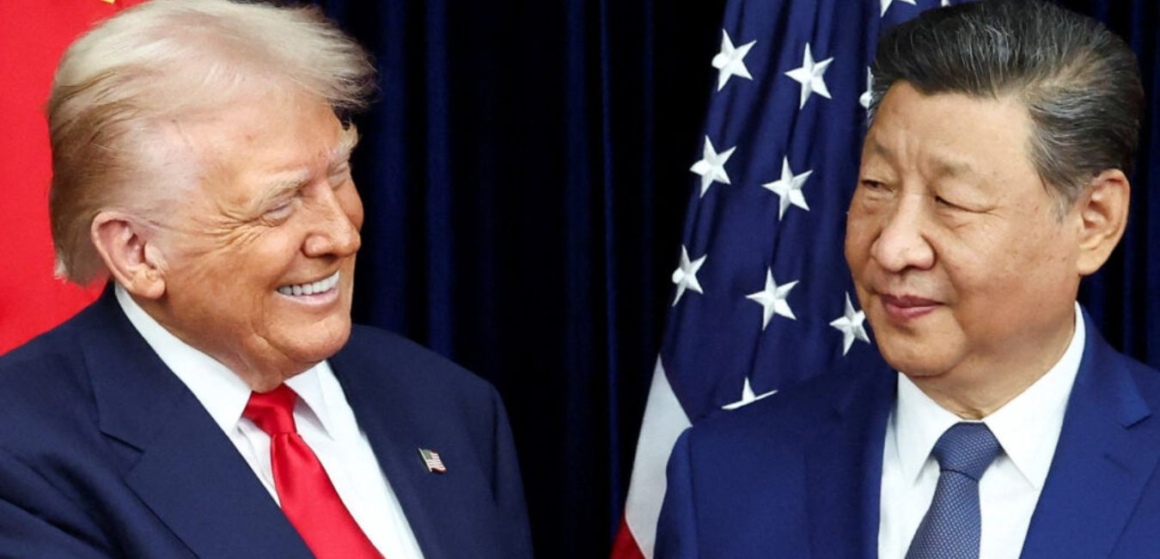
In the aftermath of a brief but high-stakes meeting between President Donald Trump and Chinese leader Xi Jinping in South Korea on Thursday, the contours of a new trade truce have begun to take shape. Though the session at a military airbase lasted less than two hours, its outcome signals a clear strategic advantage for Beijing — one that reinforces China’s steady, calculated approach to managing its economic rivalry with the United States.
The meeting did not yield a comprehensive trade accord, but both sides agreed to restore a fragile calm through a set of limited deals aimed at preventing further escalation. Xi secured a 10% reduction in the 30% tariffs that Trump had imposed earlier this year on Chinese goods. In exchange, Beijing committed to strengthening its crackdown on fentanyl exports linked to the U.S. opioid crisis. Washington also agreed to delay the implementation of a sweeping new rule that would have added thousands of Chinese companies to a U.S. technology blacklist.
For his part, Trump avoided new Chinese curbs on rare earth minerals, a crucial global resource for electronics and defense industries. U.S. officials said China will increase its purchases of American soybeans and other agricultural products, while both nations will suspend port fees and extend an existing tariff truce to maintain trade stability.
On the surface, the exchange appears even-handed, giving both leaders a way to claim success. Yet analysts say Beijing ultimately gained more ground, solidifying its “Trump 2.0” strategy — making modest concessions while extracting meaningful economic and strategic benefits.
China’s commitment to buy 25 million metric tons of American soybeans annually for the next three years, announced by U.S. Agricultural Secretary Brooke Rollins, is one example. While the figure is slightly below last year’s 26.8 million metric tons, it restores a key export flow disrupted by trade tensions. On China’s tightly managed social media, users celebrated the outcome, saying “China really nailed this tariff war” and that “Trump finally dealt with the mess Trump created.”
Still, the broader picture for China is not without challenges. Even with this year’s tariff reductions, Chinese exporters still face an average 50% duty on U.S. goods when older tariffs are factored in. Washington has also made measurable progress in narrowing its trade deficit — one of Trump’s key goals.
In addition, Beijing’s stance on TikTok appears to be softening. After months of resistance, China has reportedly shown openness to discussions over ByteDance’s compliance with a U.S. law that could force the company to sell its American operations. Meanwhile, China remains barred from accessing top-tier U.S. semiconductor technology, a central battleground in the race for artificial intelligence dominance.
One of Beijing’s biggest tactical wins came in securing at least a one-year delay on a U.S. regulation that would have vastly expanded the number of Chinese firms restricted from buying advanced American technologies. According to business intelligence firm WireScreen, that rule could have affected as many as 20,000 additional companies.
The move reflects China’s effective use of its dominance over the global rare earths supply chain as leverage — a strategy it has employed before during tariff escalations. By holding back on enforcing its own expanded export controls, Beijing kept a powerful bargaining chip without major domestic sacrifice.
Whether this newly restored calm can endure as Trump and Xi work toward a broader trade framework — and plan reciprocal visits in 2026 — remains to be seen. History offers caution: past truces with Trump have unraveled quickly.
For now, as Trump departed South Korea for a politically gridlocked Washington and Xi stayed behind to attend an international summit portraying China as a champion of globalization, one thing seems evident — the balance of power in this trade contest has shifted subtly, but unmistakably, toward Beijing.